Fast changes, slow reviews
Agents produce changes faster than people can read them. Review becomes the bottleneck, and the queue comes back.
The handbook for software teams in the age of AI
Transformation to the Agentic SDLC Made Easy
Your team already has AI agents. This book shows you how to make them useful, safe and measurable, in ninety days, with twelve hands-on labs you run on your own code.

The problem
Most rollouts stall in the same place. The agents are fine. Everything around them was never changed: what they are told, who checks their work, and how anyone knows it is helping.
Agents produce changes faster than people can read them. Review becomes the bottleneck, and the queue comes back.
An agent knows only what you put in front of it. The fact that matters most often lives in one person's head, or in a spreadsheet three folders deep.
Pull requests, prompts and tokens go up whether or not anything useful happened. Usage dashboards can't tell you if the team is getting better.
This book is about the part that isn't the tool.
How the book works
You follow Maya Iyer, who leads a team at Fernbridge, a made-up B2B software company. Each chapter opens on a day in her team's life, teaches one skill, and ends in a lab you do on your own repository.
The company, the people and every number in the story are invented. The method is real, and the labs are meant for you to measure your own team.
What's inside
An introduction on why the horse doesn't care who's riding, then:
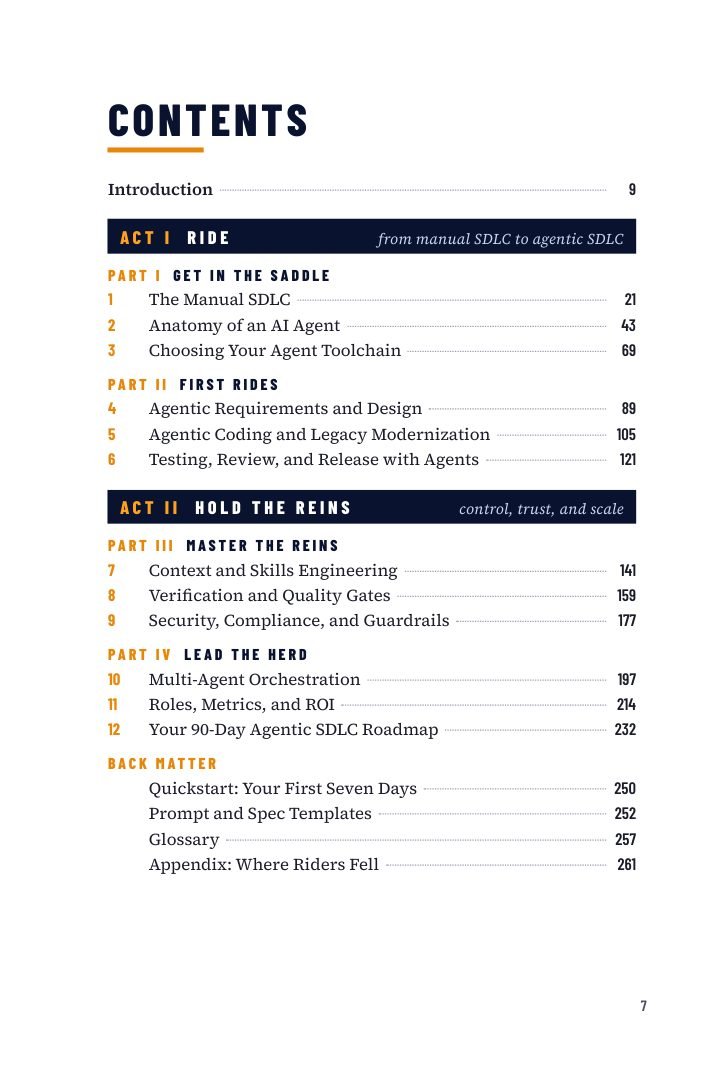
See the old process clearly, meet the agent, and make one repository ready.
Agents in every phase, from requirements to release, each ride short and checked.
The controls that keep agents inside the lines.
Several agents, honest numbers, and the plan to bring everyone along.
The back of the book is a toolkit: a seven-day Quickstart, ready-made templates for briefs, decision records and release cards, a glossary, and an appendix that retells the failures that taught the most.
Hands-on
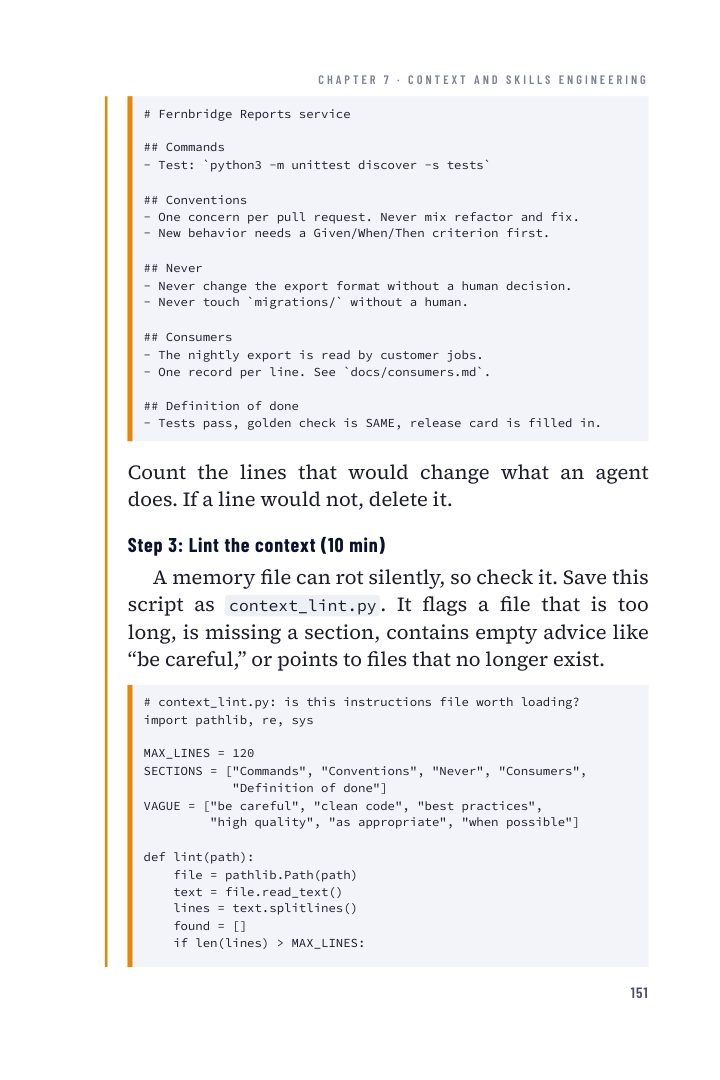
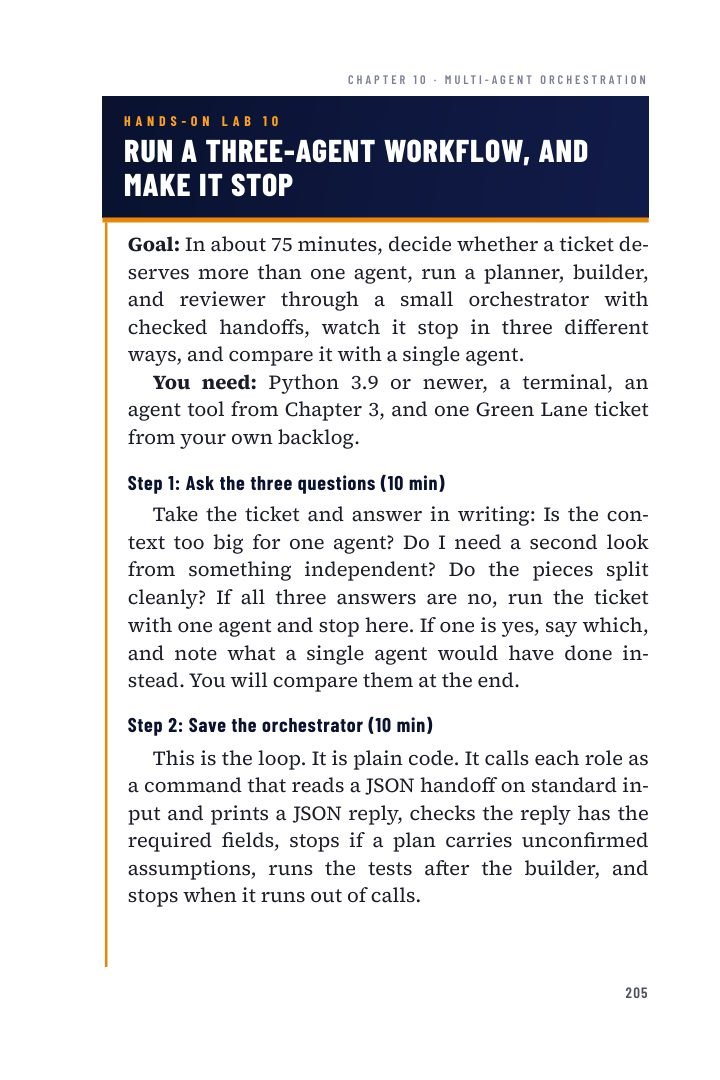
Every lab uses plain Python 3.9 or newer and plain text files. Each script was run and its output checked against the book. Here are two of them.
$ python3 context_lint.py AGENTS.md
- missing section: Conventions
- missing section: Never
- missing section: Consumers
- missing section: Definition of done
- line 2: vague 'be careful'
- line 2: vague 'best practices'
- line 6: vague 'clean code'
- stale path: src/old_module.py
8 problem(s)
$ AGENT_MODE=loop python3 orchestrate.py roles.json "Add retry"
1. planner ok
2. builder ok
3. reviewer ok
4. builder ok
5. reviewer ok
6. builder ok
STOPPED: budget: too many agent calls
The lab code is MIT-licensed, so you can take it into your own repository and your own work.
Thirteen Rider's rules
The agent knows only what you put in front of it. Write down what everyone "just knows."
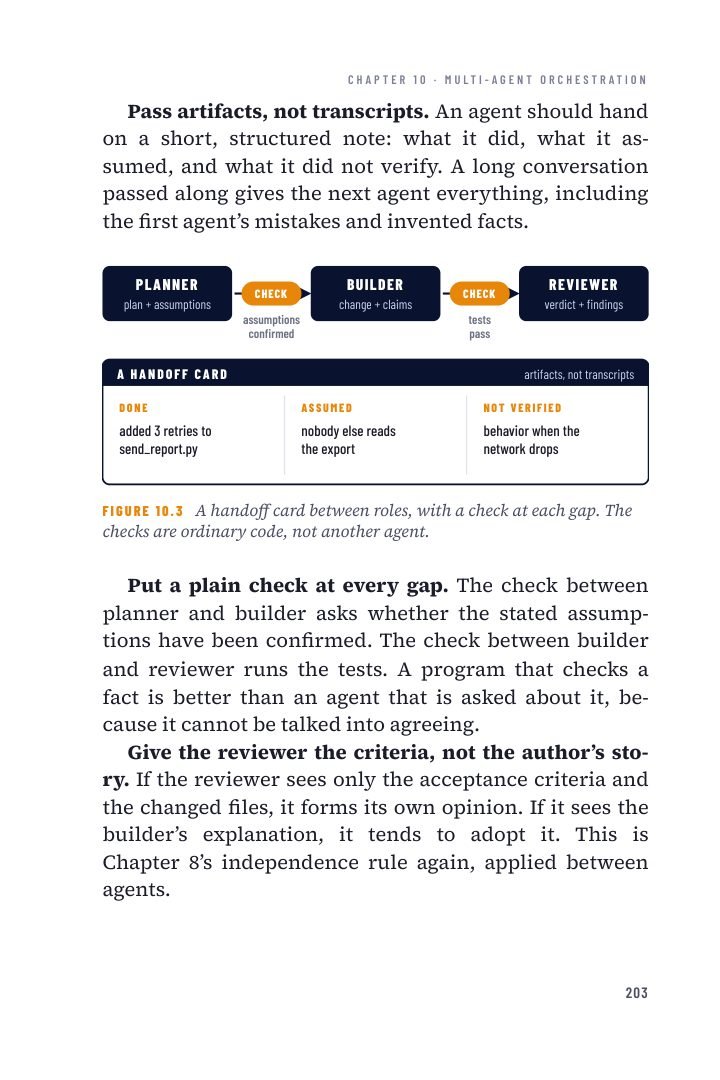
Agreement between agents is not verification. Check against something none of them wrote.
Count outcomes, not activity. A number that rises when nothing useful happened is a vanity number.
Scale the reins before you scale the herd. No team gets agents until it has its checks.
Look inside

Who it's for
What it isn't
No tool is ranked or recommended. The labs use plain Python and plain text, so they work with whichever agent your team already uses. If you want a list of clever prompts, this isn't that book. If you want your team to still be glad it adopted agents a year from now, it is.
You should be comfortable reading code and working in a repository. You don't need to be a Python expert; the scripts are short.
Free sample
Forty-four pages, free. It includes the contents, so you can see exactly what the other eleven chapters cover.
Questions
None in particular. The labs run on Python 3.9 or newer. Where a lab asks you to try a real agent, you use whichever one your team already has, and the book shows you how to swap it in.
It is for people who work with code and repositories. You don't need to be a Python expert, because the scripts are short and each one is explained. You do need to be comfortable reading a diff.
No. The company, the people and the numbers in the story are invented so the book can show a team's ninety days honestly. The labs help you measure your own.
Leave your email above and we will tell you as soon as it is available. You can also write to us at our contact address.
Yes. The lab code is released under the MIT license.
Give them the reins, the trail and a ninety-day plan.
Read a free sampleThis page does not set cookies and does not run advertising or analytics scripts. If you give us your email address to get the sample, we use it to send you the sample, news about the book's launch and occasional updates, and nothing else. We don't sell or rent it. Every email has an unsubscribe link, and you can ask us to delete your address at any time by writing to our contact address.